
Staff Deployment in Hospitals: From Ad-Hoc Planning to a Data-Driven Approach

Hospitals face major challenges. The combination of staff shortages, rising demand for care and limited resources makes the smart deployment of healthcare staff more important than ever. Yet staff planning today is still often reactive, meaning available capacity doesn't always match demand as well as it could.
A more data-driven and structured approach can change that. It helps hospitals deploy their care capacity more efficiently and keep workload better balanced.
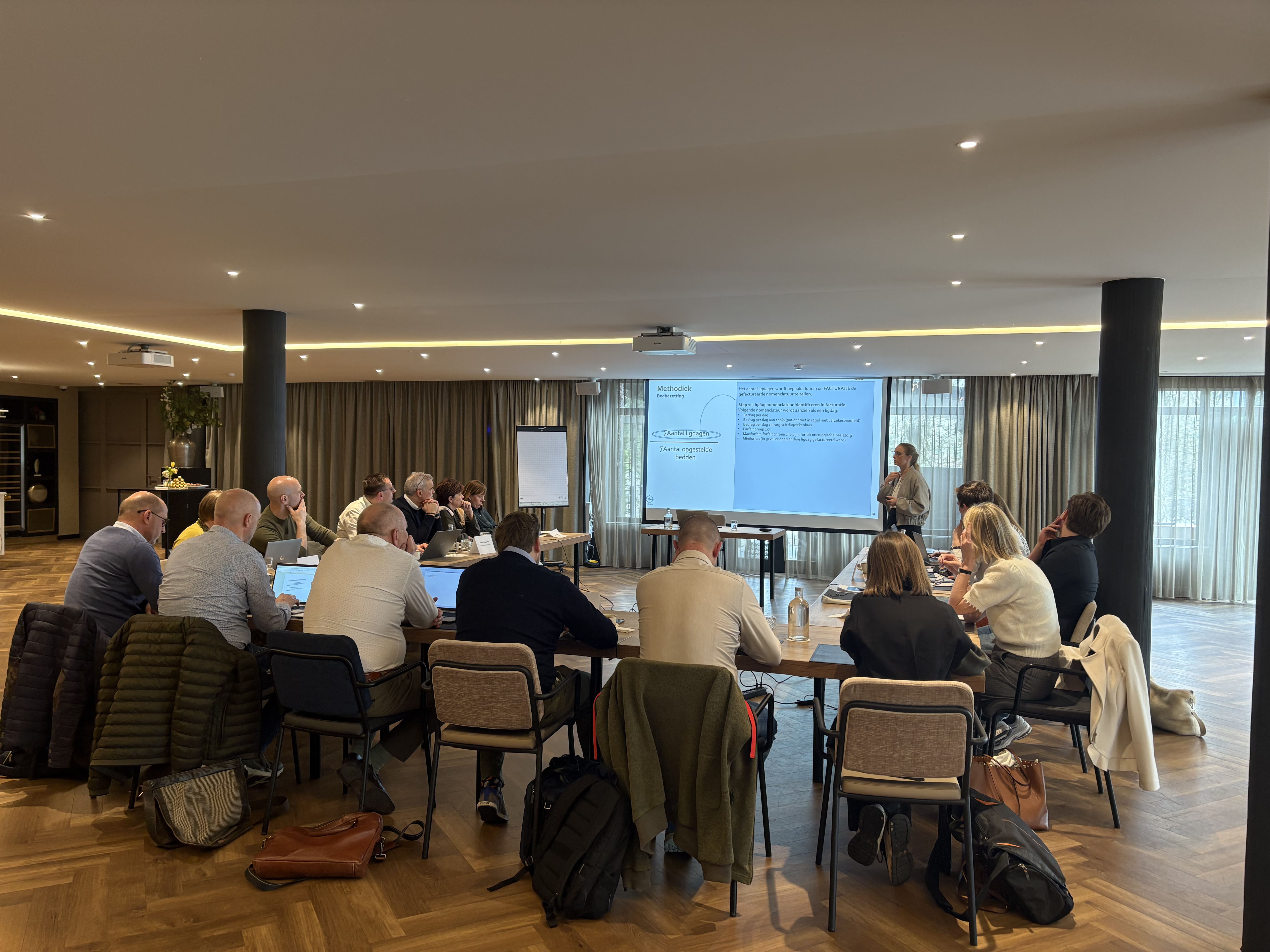
Around this theme, Value4Health recently brought together thirteen nursing directors who use the Value4Health Cockpit. During this inspiring meeting, the latest research and views were presented, and participants shared their experiences and best practices.
To this end, we gave them exclusive access to the latest views available in the V4H Cockpit:
- An overview of their bed occupancy and staff allocation (in units and euros)
- A benchmark to compare general hospitals on these two critical aspects
From collective self-reflection to the sharing of best practices, this was an opportunity to fulfill our mission — creating value for health through the use of data.
Sharing data as a starting point
In preparation for the meeting, we calculated the bed occupancy and staff deployment (expressed as the number of full-time equivalents per 1,000 patient days) per type of nursing department in each hospital. This data was thoroughly validated by each hospital, then integrated into the Value4Health Cockpit, a benchmark that gives hospitals insight into processes, costs and revenues per department and per pathology.
In addition, we analyzed and compared maturity in the area of care organization based on a self-assessment survey completed by each hospital — not only at the level of processes and systems, but also in terms of governance, organizational culture and the way data is used in decision-making.
What do the numbers tell us about staff deployment and bed occupancy?
The benchmark compared staff deployment (in full-time equivalents per 1,000 patient days) per type of nursing department across the 13 hospitals. The benchmark shows that in the internal medicine, surgery, geriatrics, psychiatry and rehabilitation departments, differences exist between hospitals, but these differences remain relatively limited. In the pediatrics, maternity and intensive care unit, these differences are considerably larger. The cause is often bed occupancy: hospitals with lower bed occupancy generally have higher staff deployment relative to the number of patient days.
The maturity scan also revealed some striking findings:
- Within every institution, plenty of data is available, but it is still coordinated and shared too little.
- The implementation of improvements based on that data varies strongly from hospital to hospital.
- According to many participants, data culture remains an area with room for growth.
Best practices exchanged
During the session, room was also made for sharing experiences and best practices regarding staff deployment and bed capacity.
How do you optimize bed occupancy?
Best practices shared during the session:
- When planning bed capacity, take seasonal fluctuations in activity into account, such as flu epidemics and holidays. Summer closures are by now a common practice everywhere.
- A discharge lounge where patients can wait until they are picked up ensures a smoother course of the entire care pathway and better use of available beds.
- Short-stay wards that close on weekends make it possible to deploy capacity more optimally.
- Some hospitals work with a flexible organizational model, with predefined levels of available beds per day or per month — for example 30, 45 or 60 beds. On weekends and during holidays, only 30 beds are then in use, 45 as standard, and during peak demand — such as during a flu epidemic — this rises to 60.
- Some hospitals work with a bed quota per specialty, while others have recently abolished this system.
Bed occupancy as a shared responsibility
A striking point from the discussions: where responsibility for bed occupancy is shared within the institution, this strengthens cohesion between teams. This shared management takes shape in a care coordination center, which meets weekly with representatives from the admissions department, the operating room, nursing and the mobile teams.
Another good idea: work with a shared, measurable goal. For example: how do we ensure that 85% of patients are referred directly to the right ward? It is precisely by jointly setting quality indicators that greater cohesion between teams emerges.
Staff deployment: what does the benchmark teach us?
During the session, the figures on staff deployment were compared. A first important step in comparing the results was understanding how care is organized in other hospitals. Factors such as the deployment of mobile staff, logistical organization, patient transport and specific accreditations (such as MCU or stroke) all have an impact on the comparability of data between institutions.
Interesting best practices were also shared in the area of staff management:
- Proactively share staff availability per ward and provide a simple way to communicate emergencies between wards, so that crises can be resolved quickly. The reliability of the shared data is crucial here.
- Use a occupancy dashboard to measure how busy the emergency department is. If busyness exceeds a certain threshold — for example 70% — nursing teams from other wards are automatically notified, so that they can take over or discharge patients where possible.
What does international literature say?
The insights from the meeting align remarkably well with international research on hospital capacity.
A few additional findings:
- One central command center for bed occupancy, admissions and transfers results in smoother patient flow and less peak pressure, several studies show.
- Aligning staff deployment with care acuity rather than fixed ratios ('acuity-based staffing') is associated with fewer healthcare-associated infections, a shorter length of stay and lower mortality.
- Flexible deployment models such as the 30-45-60 bed system generally absorb fluctuating demand for care better than fixed plans — although excessive reliance on temporary staff remains a point of attention for continuity and quality.
- Predictive data analysis based on historical occupancy and seasonal patterns makes it possible to proactively adjust staff deployment,resulting in fewer overtime hours.
- Technology alone is not enough: leadership, cross-departmental collaboration and a strong data culture determine whether improvements actually hold — just as was also noted during the meeting.
- Strong discharge coordination, combined with standardized care pathways, speeds up throughput and embeds improvements in the long term.
Next steps
The next steps that the group has set out together are to:
- Update the benchmark more frequently and more promptly so that valuable insights can be drawn from the Value4Health benchmark more quickly.
- Meet periodically to continue learning from one another.
This user meeting brought together important players from the healthcare sector around a shared goal: creating value for health.
A warm thank you to the nursing directors of Jan Yperman, AZ West, AZ Alma, VITAZ, AZ Klina, AZ Oostende, AZ Glorieux, AZ Oudenaarde, AZ Sint-Elisabeth, AZ Monica, AZ Blasius, AZ Vesalius and AZ Sint-Franciscus.
Want to join the next session? Get in touch with us!

Get in Touch with Us
Do you have questions or need assistance? Our team is here to help you optimise your hospital's operations and financial sustainability.